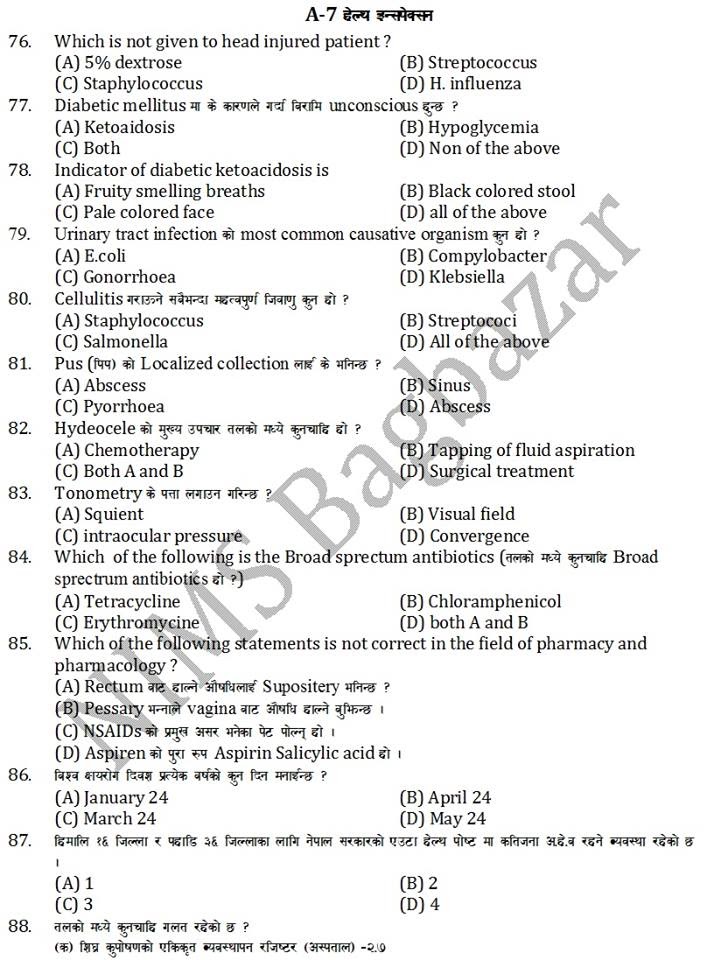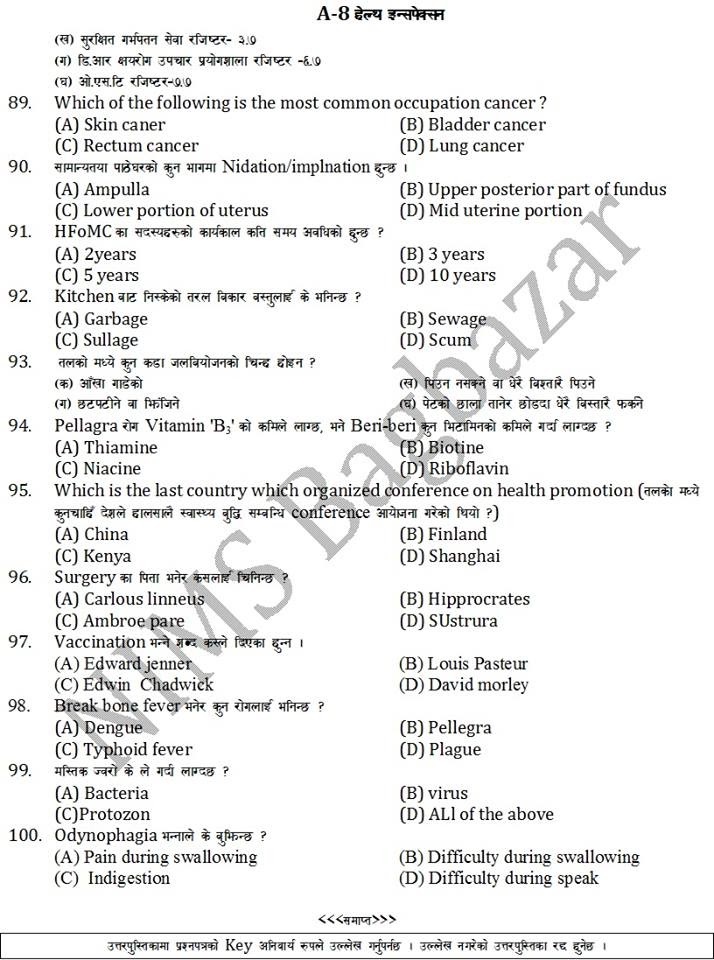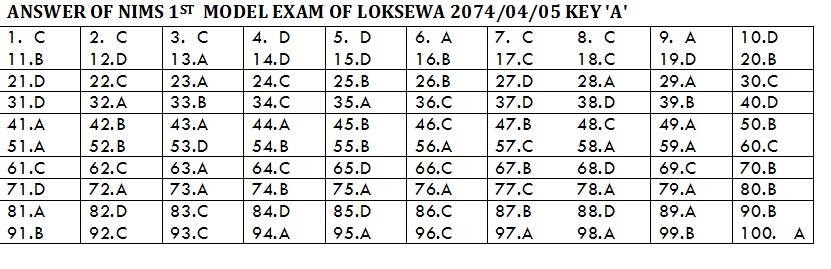
Most important questions and answers

Public Health Programme and Management
SET 10

  1. Which of the following is the popular method of community diagnosis?
    (a) House hold survey (b) PRA (c) RRA (d) Sample study
  2. …………. is the policy formulator.
    (a) Cabinet (b) Department of health (c) HOD (d) Respective ministry
  3. The father of scientific management is ………….
    (a) Henry Fayol (b) FW Taylor (c) Hippocrates (d) Luther Gullick
  4. Health is an equilibrium between man, his environment and disease. This is ……….concept.
    (a) Biomedical (b) Holistic (c) Psychosocial (d) Ecological
  5. One-to-one relationship is given by ………..
    (a) Germ theory of disease (b) Epidemiological triad (c) Web of causation
    (d) Multifactorial causation
  6. Time is ……….. of management.
    (a) Expandable resource (b) Non-expandable resource (c) Non-renewable resource (d) None of the above
  7. Which is not a component of communication process?
    (a) Communicator (b) Message (c) Audience (d) Meeting place
  8. Purpose of disciplinary action is …………..
    (a)To avoid future errors (b) To improve the performance (c) To punish repeated mistakes
    (d) All of the above
  9. Sample survey refers to ……………
    (a) Demographic study (b) House hold survey (c) Study of some part total population (d) Study of total population
  10. Monitoring is necessary to do in …………..
    (a) Mid term of programme
    (b) Periodic basis
    (c) Continue basis of programme period (d) Beginning phase of implementation
  11. Full form of CDP is ………..
    (a) Community drug programme
    (b) Community disease control programme
    (c) Community dental programme
    (d) None of the above
  12. Which is not the tool for supervision?
    (a) Working manuals (b) Implementation
    (c) Check-list (d) Job description
  13. Recommendation rewards especially to ……….
    (a) Obvious, honest, labourious and devoted founds public
    (b)Obvious, honest, labourious and devoted founds own family
    (c)Both b and c
    (d)None of the above
  14. What are the barriers of delegation?
    a(a) Superiority complex (b) Inferiority complex (c) Love of the power (d) All of the above
  15. Components of in-service education include……..
    (a) Orientation (b) Skill training (c) Continuous learning (d) All of the above
  16. Delegation is the process of ………….
    (a) Distributing responsibility and authority downwardly in an organization
    (b)Distributing of work among the staff/team members for providing qualitative care to the clients
    (c) A process of exchanging ideas with one another
    (d) The direction, accomplished by authority of the work of others
  17. What types of evaluation is done between the cources?
    (a) Formative (b) Summative (c) Diagnostic (d) Placement
  18. The process of influencing group activities toward then accomplishment of goals in a given situation is:
    (a) Leader (b) Leadership (c) Management (d) Manager
  19. Assigning right job to the right people is the management function of …..
    (a) Planning (b) Organizing (c) Staffing (d) Leading and directing
  20. Leaders who keep the decision – making authority and control in their own hands and assume full responsibility for all actions are:
    (a) Democratic leadership (b) Autocratic leadership (c) Laissez-faire (d) Situational leaders
  21. In which type of leadership style, there is a feeling of “togetherness”:
    (a) Democratic leadership (b) Autocratic leadership (c) Laissez-faire (d) Situational leadership
  22. In which types of leadership style, the leader is just a figure head and he acts principally as liaison between the groups and outside elements:
    (a) Democratic leadership (b) Autocratic leadership (c) Laissez-faire (d) Situational leadershi
  23. The best types of leadership is …………
    (a) Laissez-faire (b) Autocratic (c) Democratic (d) Directive
  24. A person who coordinates the work of other is known as…
    (a) Coordinator (b) Leader (c) Manager (d) Communnicator
    Read Also:
    Lok Sewa Aayog – Questions Answer | Medical
    Lok Sewa Aayog – Important Notes
  25. …..is the unit of measurement used in community diagnosis.
    (a) Incidence (b) Morbidity (c) Mortality (d) All of the above
  26. Democratic leadership style is also known as:
    (a) Participative (b) Free-rein (c) Agitator (d) Charismatic
  27. Factors affecting leadership are:
    (a) Social and cultural background and political and economical environment
    (b)Education and Experiencess
    (c)Causalities of a leader and socialisms demand for certain types of leadership[
    (d)All of the above
  28. “Getting the things done” is the definition of ………
    (a) Management (b) Leadership (c) Organization (d) Leader
  29. Which is the area of school health programme?
    (a) School health environment (b) School health service (c) School health teaching (d) All of the above
  30. Which is the area of school health programme?
    (a) Competent (b) Courageous (c) Honesty (d) Visionless
  31. What are the tools of evaluation?
    (a) Questionnaires (b) Rating scales
    (c) Anecdotal records (d) All of the above
  32. To complete evaluation, what is needed?
    (a) Midterm data (b) Baseline survey data (c) Final term data (d) all of the above
  33. What is the most important task to be done in planning?
    (a) Selecting the staff (b) Determining goals (c) Managing physical facilities (d) Operating the work
  34. What is the importance of supervision?
    (a) Evaluation of staff (b) Identify problem and solve it (c) Improving workers skill (d) All of the above
  35. Lottery system is used in ……….
    (a) Quota Sampling (b) Restricted sampling (c) Simple random sampling (d) Non-probability sampling
  36. Which is a motivator?
    (a) Unclear job description (b) Personal development (c) Inefficient leadership
    (d) Low salary
  37. Health profile includes the information of …………
    (a) Information of health post
    (b) Information of PHC
    (c) Information of whole country
    (d) Information of specific area like VDC, district
  38. Which is a demotivator?
    (a) Communication and education (b) Participation and involvement
    (c) Creating good working condition (d) Unclear job description
  39. Positive motivation is also called………
    (a) Push mechanism (b) Intrinsic motivation (c) Extrinsic motivation (d) Pull mechanism
  40. Which of the following is a “push mechanism” of motivation?
    (a) Praise (b) Promotion (c) Pay cheque (d) Punishment
  41. Which of the following is “pull mechanism” of motivation?
    (a) Punishment (b) Fear of loosing job
    (c) Threatenning (d) Promotion
  42. Process of motivation is orderly:
    (a) Needs, tension, wants, satisfication
    (b) Needs, wants, tension, action, satisfication
    (c ) Wants, action, tension, needs, satisfication
    (d) Tension, needs, wants, action, satisfication
    Who is the supervisor of health post incharge?
    (a) Accountant (b) Doctor (c) DTCA (c) PHO
  43. Inventory management refers to ……………
    (a) Reporting of logistic supply
    (b) Replacement, supply, storing and proper recording of goods (c) Supply of the goods health post (d) Supply of the goods institution yearly basis
  44. Nepal Living Standard Survey was carried out for ……… time in 2003/2004?
    (a) 1 (b) 2 (c) 3 ` (d) 4
  45. The first step of planning is:
    (a) Set goal/objective (b) Prioritize needs/problems
    (c) Write/prepare plan to implement (d) Distribute work activities
  46. A good plan should be:
    (a) Simple (b) Flexible (c) Practicable (d) All of the above
  47. If leaders are using ANM because staff nurse are lacking in the working place, here leaders are following which management principles?
    (a) Management by objectives (b) Division of labour (c) Substitution (d) Learning from experience
  48. Which of the following is a popular method of community diagnosis?
    (a) House hold source (b) PRA (c) RRA (d) Both a & b
  49. Which of the following method can be applied to collect data for evaluation of health program?
    (a) Interview (b) Performance reviews
    (c) Task analysis (d) All of the above
  50. Which of the following method can be applied to collect data for evaluation of health program?(a) Interview (b) Performance reviews(c) Task analysis (d) All of the above

Most important questions and answers

PUBLIC HEALTH PROGRAMME AND MANGEMENT
SET-3

  1. Which of the following is the general characteristic of new born baby?
    a. AGAR score below 7 b. APGAR score 7-10 c. APGAR score above 10 d. None of the above
  2. Most satisfactory method of collecting data is …
    a. Oral questionnaire b. Postal questionnaire
    c. Result of experiments d. First hand reports
  3. Quantitative data can be represented in …
    a. Pictogram b. Pie diagram c. Histogram d. Bar diagram
  4. The percentage is depicted by …
    a. Bar chart b. Pie chart c. Histogram d. Pictogram
  5. The Incubation period range of kala-azar is …
    a. 7 to 28 days b. 14 to 42 days c. 10 days to 2 years d. 14 days to many years
  6. Census is usually carried difference of:
    a. 12 years b. A decade c. 15 years d. A dentury
  7. Which of the following drug is useful for AIDS?
    a. Azathioprine b. Interferon c. Vidarabine d. Zidorvdine
  8. The calculate vital statistics the population used is as on:
    a. January 1 b. April 1 c. July 1 d. October 1
  9. What is the incubation period of kala-azar?
    a. 1-2 weeks b. 2-4 weeks c. 2-6 months d. 1-2 weeks
  10. A Japanese encephalitis epidemic was seen in … district in Nepal for the first time?
    a. Jhapa b. Morang c. Rupandehi d. Sunsari
  11. Egg supplies all nutrients except …
    a. Fat b. Minerals c. Vitamin A d. Vitamin C
  12. Demography is the study of all except …
    a. Fertility b. Mortality c. Migration d. Morbidity
  13. The second long term health plan period is started from:
    a. 1995-2015 AD b. 1996-2016 AD c. 1997-2017 AD d. 1998-2018 AD
  14. Which of the following species of mosquito transfers Japanese encephalitis?
    a. Anopheles b. Cerlicine c. Culex d. None
  15. Which animal is closet when organ transplant to human being is attempted?
    a. Chimpanzee b. Dog c. Monkey d. Pig
  16. Which vaccine is given for prevention of TB?
    a. BCG b. DPT c. Oral polio d. TT
  17. Most university accepted indicator of health status of whole population is:
    a. Crude death rate b. Infant mortality rate c. Child mortality rate d. Maternal mortality rate
  18. By second long term health plan period, the MMR will be reduced from 281/ lakh to:
    a. 258/lakh b. 250/lakh c. 247/lakh d. 240/lakh
  19. The transmission of malaria can be significantly reduced by
    a. Anti mosquito measures b. Chemoprophylaxis c. Radical chemotherapy d. None of the above
  20. Malaria parasite in mosquito has the … stages.
    a. Okinete b. Oocyst c. Sporozite d. Zygote
  21. According to demographic health survey 064/065, the recent contraceptive prevalence rate of Nepal is:
    a. 39% b. 42% c. 44% d. 47%
  22. Which of the following is the largest sinus?
    a. Ethmoidal b. Frontal c. Maxillary d. Sphenoidal
  23. The denominator for calculating infant mortality rate is:
    a. Mid year estimated population b. Number of infants
    c. Number of live birth in one year d. Number of birth in one year
  24. Which of the following opportunistic fungal infections is seen in AIDS?
    a. Cryptococcus b. Coccidioides c. Candida d. All of the above
  25. According to annual report 2065/2066, the 4th ANC visit coverage is:
    a. 7% b. 49.8% c. 55.9% d. 58.5%
    Also Read:
    LOK SEWA AAYOG – PRIMARY HEALTH CARE REVITALIZATION
    LOK SEWA AAYOG – CAUSES OF DISEASE AND INFECTION
  26. The world AIDS day is celebrated on …
    a. 1st January b. 1st April c. 1st May d. 1st December
  27. Which is the general pulse rate of new baby?
    a. 90-120 times/ min b. 100-120 times/ min c. 120-140 times/ min d. 140-160 times/ min
  28. Which of the following provides maximum energy?
    a. Carbohydrate b. Fat c. Protein d. Vitamin
  29. The 1st five year plan period was between:
    a. 1952-1952 b. 1954-1959 c. 1956-1961 d. 1958-1963
  30. All of the following are malaria control strategies except …
    a. Prevention & control of epidemics with particular reference of p falciparum malaria
    b. ICE for the use of personal protection measures (Simple bed not or INTS), treatment seeking behavior and compliance
    c. Promotion of operational field research or evidence based decision making in malaria control
    d. Training or increased competence of periplural level health status in malaria control
  31. … is associated with defense mechanism of human body?
    a. RBC b. WBC c. Platelets d. None of the above
  32. Kala-azar is also known as …
    a. Genetic disease b. Hormonal disease c. Vector born disease d. Water disease
  33. The best time for collecting blood sample for microfilaria is
    a. 8:00 pm – 10:00 am b. 2:00 am – 6:00 am c. 6:00 am – 6:00 pm d. All of the above
  34. The disease that may be transmitted by “Tatooing” is …
    a. AIDS b. Cancer c. Gonorrhoea d. Hepatitis B
  35. Respiratory unit comprises of …
    a. Alveoli b. Alveolar duct alveoli c. Terminal bronchial-alveoli d. Respiratory bronchiole-alveoli
  36. The safe motherhood program was initiated in Nepal in …
    a. 1992 b. 1994 c. 1996 d. 1998
  37. A man with heavy smoking habit for many years is caught by cough breathlessness is suffering from …
    a. Chronic bronchitis b. Asthma c. Both a & b d. None
  38. Which of the following blood cells is primarily affected in AIDS?
    a. B-Lymphocytes b. Monocytes d. RBC d. T-Lymphocytes
  39. Which of the following indicates severity of illness?
    a. Case fatality rate b. Prevalence rate c. Proportional mortality rate d. Incidence rate
  40. … is a feature of asymptomatic carrier state.
    a. AIDS dementia b. Fever c. Splenomegaly d. Persistent generalized lymphadenopathy
  41. How much protein in required for an adult daily?
    a. 5 gram/ kg body wt b. 1 gram/ kg body wt c. 1.5 grams/ kg body wt d. 2 grams/ kg body wt
  42. External respiration is the process of …
    a. Exchange of gases b. Exchane of O2 and Co2 c. Exchange of CO2 & Co3 d. Exchange of O2 & O3
  43. 1 gm. Of Hemoglobin carries … of oxygen.
    a. 34 ml b. 1.5 ml c. 2 ml d. 3 ml
  44. Which is the most common cause of nutritional anemia?
    a. Floate deficiency b. Iron deficiency c. Vitamin B12 deficiency d. Pyridoxine deficiency
  45. Weaning foods refer to …
    a. Birthday dishes b. Complementary food c. Royal dishes d. Supplementary food
  46. The first national immunization day (NID) was successfully conducted in Nepal on …
    a. Mangsir 22 & Magh 5, 2054 b. Mangsir 21 & Magh 4, 2055
    c. Mangsir 20 & Magh, 2056 d. Mangsir 22 & Magh 4, 2057
  47. Which is the dangerous sign in ARI?
    a. Convulsion b. Unable to drink c. Severe malnutrition d. All of the above
  48. The IMCI is short form of …
    a. Integrated management of childhood illness
    b. Integrated management of chronic illness
    c. Integrated management of clinical illness
    d. Integrated management of clinical investigation
  49. Which of the following continent is free from Japanese encephalitis?
    a. Europe b. Australia c. America d. All of the above
  50. ARI does not includes …
    a. Epiglottitis b. Otitis media c. TB d. Tracheobronchitis

By Rajiv Kumar Yadav
Most important questions

PUBLIC HEALTH PROGRAMME AND MANGEMENT

  1. When was the department of health service established?
    a. 1930 AD b. 1933 AD c. 1935 AD d. 1940 AD
  2. Five-year health plan in Nepal was initiated in …
    a. 1949 AD b. 1950 AD c. 1951 AD d. 1952 AD
  3. Family planning association started its activities in Nepal in
    a. 1959 AD b. 1966 AD c. 1977 AD d. 1989 AD
  4. Which of the following is the first public health program in Nepal?
    a. Dengue control programme
    b. Leprosy control programme
    c. Malaria eradication programme
    d. TB control programme
  5. Which is the objective of family planning?
    a. To avoid unwanted birth and to bring about wanted births
    b. To control the time at which birth occur in relation to the ages of the parents
    c. To determine the numbers of the children in the family
    d. All of the above
  6. Family planning is necessary for …
    a. Making the family happy b. Better child health c. Better mental health d. All of the above
  7. What do you mean by eligible couple?
    a. 20-40 year married couple b. 15-49 years unmarried couple c. 15-45 years married couple d. 15-39 years married couple
  8. Family planning refers to practical that …
    a. Regulated intermission between pregnancies
    b. Brings about wanted birth
    c. Avoids unwanted birth
    d. All of the above
  9. Which of the following is not the natural method of family planning?
    a. Safe period b. Abortion c. Breast feeding d. Coitus interrupts
  10. Oral contraceptive method for spacing between pregnancies is …
    a. Oral pills b. Diaphragm c. IUD d. Condom
  11. The ideal contraceptive measure for a newly married couple is …
    a. Oral pills b. Vasectomy c. Tubectomy d. Coitus interrups
  12. Naturally family planning can be done by …
    a. Minilap b. Condom c. Pills d. Coitus interrupts
  13. Mechanism of action of combined oral pills is …
    a. Preventing the release of ovum from ovary
    b. Preventing the implantation
    c. Increase the viscosity of cervical mucus
    d. Preventing of fertilization of ovum
  14. Which of the following is being tried as the male pill?
    a. Gossypol b. DMPA c. Quienestral d. Now-ethindron
  15. Which of the following is not true about cu-T?
    a. High expulsion rate b. Low expulsion rate
    c. Increased contraceptive effectiveness d. Not effective as post coital contraceptives
  16. Progesterone only pill are known as …
    a. Macro pill b. Micro pill c. Mini pill d. Both b and c
  17. Norplant contains …
    a. Levo norgestrel b. Norgestrol c. Estrogen d. Norethindron
  18. Which of the following method can prevent STDs and HIV AIDS?
    a. Depo-Provera b. Condom c. Copper-T d. Norplant
  19. Which is the suitable time to take Depo-Provera first?
    a. Within 5 days of menstrual period
    b. Within 7 days of menstrual period
    c. After 7 days of menstrual period
    d. Anytime when she wants
  20. When was Bir Hospital established?
    a. 1987 b. 1988 c. 1989 d. 1990
  21. DMPA stands for …
    a. Dextro-maltose progesterone acetate b. Depot-maltose progesterone acetate
    c. Depot-medoxy progesterone acetate d. Drunal-medoxy progesterone acetate
  22. EPI (Expanded program on immunization) was launched by WHO in …
    a. 1974 b. 1975 c. 1987 d. 1980
  23. The usual does of DMPA is …
    a. 200 mg every 3 months b. 150 mg every 3 months c. 250 mg every 3 months d. 350 mg every 3 months
  24. The effectiveness of oral contraceptives is reduced by …
    a. Rifampicin b. Phenobarbital c. Levonorgestrel d. All of the above
  25. Norplant contains …
    a. Norethiterone b. Norgestrol c. Levonorgestrel c. Ehinyl estradiol
    Also Read:
    LOK SEWA AAYOG – PRIMARY HEALTH CARE OUTREACH CLINIC
    Lok Sewa Aayog – Tuberculosis
  26. The total number of condoms required by a couple during whole year …
    a. 12 b. 72 c. 144 d. 288
  27. Diaphragm method of contraceptive combines with …
    a. IUCD b. Spermicide jelly c. Condom d. Foam tablet
  28. How many quantity of Progestine and Estrogen in Nilocan White presents respectively?
    a. 3 & 30 mg b. 1.0 & 35 mg c. 0.5 & 35 mg d. 1.0 & 30 mg
  29. By safe period method, the sexual intercourse should be avoided form … day of menstrual cycle.
    a. 10 – 19 b. 8 – 22 c. 8 – 20 d. 14 – 22
  30. Copper-T is the …
    a. First generation IUD b. Second generation IUD c. Third generation IUD d. Fourth generation IUD
  31. Which is the barrier method of family planning?
    a. Physical method b. Chemical method c. Non of the above d. Both a and b
  32. Which of the following is chemical barrier method of family planning?
    a. Panther b. Kamal chakki c. Diaphragm c. Condom
  33. All are barrier contraceptives except …
    a. Condom b. Diapphragm c. IUDs d. Spermicide jelly
  34. The yellow part of an egg contains …
    a. Carbohydrate b. Fat c. Minerals d. Protein
  35. All are complication of IUD except …
    a. Increased vaginal bleeding b. Pelvic inflammatory disease c. Ectopic pregnancy d. Suppression of lactation
  36. Norplant is used …
    a. Over penis b. Under the skin c. In the uterus d. Orally
  37. … is not genetic disorder in pregnancy.
    a. Advanced age b. Ethnicity c. Family history d. Health disease
  38. IUDs should be inserted during …
    a. Menstrual period b. 6-8 days after delivery c. After pregnancy test negative d. All of the above
  39. Which of the following is objective of family planning?
    a. To control the time at which birth occur in relation to the ages of the parent
    b. To avoid unwanted births and to bring about wanted births
    c. To determine the number of the children in the family
    d. All of the above
  40. Which is the ideal method in interval use for women greater than the 35 years?
    a. Pills b. Kamal chakki c. IUD d. Depo-Provera
  41. The first health assistant (HA) institute in Nepal was started in
    a. 1955 b. 1956 c. 1957 d. 1958
  42. The failure rate of Copper-T is about …
    a. 1-2% b. 3-5% c. 5-10% d. 10-15%
  43. Which is not oral pills of hormonal method of family lanning?
    a. Combined pill b. Injectables c. Mini pill d. Post coital pill
  44. The commonest side effect of women fitted with IUD is …
    a. Pelvic infection b. Backache c. Increased vaginal bleeding d. Uterine perforation
  45. Liver can store vitamin A up to …
    a. 6-9 months b. 9-12 years c. 12-18 years d. 2 years
  46. DPT vaccine in given against …
    a. Diphtheria & tetanus b. Diphtheria, typhoid & polio
    c. Diphtheria, typhoid & tetanus d. Diphtheria, tetanus & whooping cough
  47. Which of the following record is kept in nutritional assessment of a baby?
    a. Arm circumference b. Height c. Weight d. All of the above
  48. Which of the following contraceptive method is most commonly used in Nepal?
    a. Depo-Provera b. Oral pills c. Copper-T d. Norplant
  49. Which of the following is not the family planning spacing method?
    a. Hormonal method b. Barrier method c. Intra uterine devices d. Male sterilization
  50. Which is the symptom and sign of kala-azar?
    a. Fever, haematuria, cough
    b. Fever, difficulty to breathing, and swollen in lower limb
    c. Fever, anaemia, weight less and splenomeglay
    d. Headache, sore throat, fever, redness of eye
    Answer sheet
  51. b 2. c 3. a 4. c 5. d 6. d 7. c 8. d 9. b 10. a 11. d 12. d 13. a 14. a 15. b 16. d 17. a 18. b 19. b 20. c 21. c 22. a 23. b 24. d 25. c 26. b 27. b 28. b 29. b 30. b 31. d 32. b 33. c 34. d 35. d 36. b 37. d 38. d 39. d 40. c 41. b 42. b 43. b 44. c 45. a 46. d 47. d 48. a 49. b 50. c

By Rajiv Kumar Yadav
Most important questions and answers of public health programs and management

By Rajiv Kumar Yadav
Set 4

  1. Vitamin A (2,00,000 IV) should be given within… days of delivevery.
    (a) 28 (b) 35 (c) 42 (d) 49
  2. ……………… indicates the chronic malnutrition?
    (a) Decreased height for age (b) Decreased weight for age
    (c) Decreased weight for height (d) All of the above
  3. Generally, Measles vaccine is given at the age of ………..
    (a) 2 months (b) 3 months (c) 6 months (d) 9 months
  4. All of the followings are energy giving foods except ………..
    (a) Cereals (b) Fats (c) Vegetables (d) Tubers
  5. Which is the dangerous sign in pregnancy?
    (a) Roximin (b) Sever headache (c) UTI (d) All of the above
  6. Incidence is defined as:
    (a) Number of case existing in a given population at a given movement
    (b) Numbers of case existing in a given period
    (c) Numbers of new cases occurring during a specified period in a given population
    (d) Number of old cases present during a specified period in a given population
  7. Which one of the exposure has highest efficiency of transmission of AIDS?
    (a) Contaminated blood transfusion (b) Infected mother to child (c) Intravenous drug abusers (d) Sexual intercourse
  8. How many stages are occurred in Malariya?
    (a) 3 (b) 4 (c) 5 (d) 6
  9. Japanese encephalitis was first observed in Nepal in…..
    (a) 1975 (b) 1978 (c) 1981 (d) 1985
  10. How much energy is provided by one gram of carbohydrate?
    (a) 3 kcal (b) 4 kcal (c) 5 kcal (d) 6 kcal
  11. Total number of causes (old + new) at a given point of time in a given population is:
    (a) Incidence (b) Prevalence (c) Epidemiology (d) Attack rate
  12. The full form of EPI is ……….
    (a) Expanded program of immunization (b) Expanded program on immunization
    (c) Expanded project on immunization (d) Extra program on immunization
  13. Prevalence is useful:
    (a) To identify potential high risk population
    (b) To control disease
    (c) For distribution of disease
    (d) Efficiency of preventive and therapeutic measure
  14. The commonest cause of infant mortality rate is:
    (a) Diarrhoea (b) prematurity (c) Reparation infection (d) Malnutrition
  15. Which of the following is the richest source of protein?
    (a) Bean (b) Egg (c) Meat
    (d) Soyabean
  16. Which prevents from SYTD’s and AIDS?
    (a) Condom (b) Copper T (c) Depo-Provera (d) Norplant
  17. Health education is:
    (a) Give immunization
    (b) Secondary level of prevention
    (c) Change in belief, attitude and habits f people
    (d) Awareness about health problem
  18. When mosquito sucks Japanese encephalitis virus, after what time it becomes infective stage?
    (a) 7 days (b) 10 days (c) 14 days (d) 21 days
  19. Respiratory zone stars ………. Of bronchial tree.
    (a) 15 generation onwards (b) 16 generation onwards (c) 17 generation onwards (d) 17 generation onwards
  20. All are true about principle of health education except:
    (a) Participation (b) Interest (c) Adoption (d) Comprehension
  21. Which of the following is main objective of safer motherhood?
    (a) Safe delivery without disturbing the life of mother (b) Safe delivery without disturbing the life of baby
    (c) Both a & b
    (d) None of the above
  22. Which of the followings are water soluble vitamins?
    (a) A, B, C, D (b) A, D, E, K (c) B & (d) K & C
  23. The infant born before …… weak is called premature infant.
    (a) 28-40 (b) 30-40 (c) 35 (c) 40
  24. ………. district implemented IMCI (Integrated management of childhood illness) first of all.
    (a) Bara (b) Mahottari (c) Sunsari (d) Udayapur
    Also Read:
    Lok Sewa Aayog – Objective Questions Answer | Medical
    LOK SEWA AAYOG – PRIMARY HEALTH CARE REVITALIZATION
  25. Which of the following symptom isn’t seen in pregnant mother?
    (a) Lightening (b) Morning sickness (c) Quickening (d) Frequently micturation
  26. The western blot is a confirmatory test associated with ……….
    (a) AIDS (b) Gonorrhea (c) Syphilis (d) All of the above
  27. IEC stands for:
    (a) Information, education and communication
    (b) Informal executive committee
    (c) Informing, educating and communicating
    (d) International education committee
  28. What was the main objective of leprosy control?
    (a) To reduce disability rate at the national level
    (b) To minimize social stigma of the disease
    (c) To eliminate leprosy from the country by the end of 2005 bringing down the leprosy prevalence rate to below 1 per 10000 population
    (d)All of the above
  29. The most cost-effective and successful health intervention programme of Nepal is …………..
    (a) EPI (b) Family planning (c) Malaria eradication (d) School health
  30. The composition of ‘Sarbottam pitho’ is ……….
    (a) Soyabean : wheat : corn – 1:1:1 (b) Soyabean : wheat : rice – 1:1:1
    (c) Soyabean : whet : corn – 2:1:1 (d) Rice : wheat : corn – 2:1:1
  31. Which is not an objective of school health programme?
    (a) Prevention of diseases (b) Promotion of rehabilitation
    (c) Promotion of positive health (c) Make consciousness of their own health
  32. Mosquito that prefers human blood as food is called…….
    (a) Anthrophillic (b) Biophilic (c) Gyanephilic (d) Humanphilic
  33. Which of the following is not s STD?
    (a) Candiases (b) Gonohorrhea (c) Hepatitis B (d) Syphilis
  34. The best method of teaching an urban slum area about ORS is:
    (a) Lecture (b) Role play (c) Brain storming (d) Demonstration
  35. What is the scientific name of culex that causes Japanese encephalitis?
    (a) Culex gledius (b) Culex vishni (c) Culex traitaeniorhyncus (d) Culex fuscocephala
  36. The chemical used for indoor residual spraying to control kala-azar is ………
    (a) Alpha cypermethin (b) DDT (c) Malathion (d) Pyrimrthaamine
  37. Kala-azar is an endemic disease nearly in ……………… districts.
    (a) 10 (b) 12 (c) 30 (d) 75
  38. How many districts in present are covered by ARI in Nepal?
    (a) 50 districts (b) 60 districts (c) 70 districts (d) 75 districts
  39. All are true about the key elements of communication except……..
    (a) Communicator (b) Message (c) Channel of communication (d) Behavioral changes
  40. Which of the following is not visual aids?
    (a) Hand bill (b) Holding board (c) Slide tape (d) Epidiascope
  41. The incubation period of P. Virus is ……… days.
    (a) 8-25 (b) 8-15 (c) 8-35 (d) 8-45
  42. Which media is generalized to give health education in Nepalese context?
    (a) Radio (b) Television (c) Video (d) Newspaper
  43. Oral polio vaccine is developed by ………
    (a) Barnard Christian (b) Koch (c) Sabin (d) Stalk
  44. What will be the incidence rate of kala-azar within 2015 according to Nepal Government’s Health Ministry’s aim for kala -azar control?
    (a) 2/lakh by 2015 (b) 2/lakh by 2010 (c) 1/lakh by 2015 (d) 10/lakh by 2010
  45. Which of the following is an example of community participation?
    (a) Building of health post by MOH
    (b) Building of primary health care by MOE
    (c) Building of health post by VDC with an aid from government (d) None of the above
  46. The major doner of HEIC programs is ……….
    (a) UNFPA (b) WHO+USAID (c) DFID/IDA (d) All of the above
  47. Stage of dying where the patient blames everyone for his misfortune is ……
    (a) Denial (b) Anger (c) Bargaining (d) Depression
  48. Which is the main function of child health clinic?
    (a) Health education (b) Immunization (c) Monitoring growth (d) All of the above
  49. Mucosal ulcer is seen in ………… stage of syphilis
    (a) First stage (b) Secondary stage (c) Tertiary stage (d) Late stage
  50. Mosquito that prefers animal blood as food is called ……
    (a) Athrophilic (b) Biophilic (c) Heterphilic (d) Zoophilic
    Answer Shee 1.c 2. a 3. d 4. c 5. d 6. c 7. a 8. a 9. b 10. b 11. b 12. b 13. a 14. b 15. d 16. a 17. c 18. c 19. b 20. c 21. c 22. c 23. a 24. b 25. a 26. a 27. a 28. d 29. a 30. c 31. b 32. a 33. c 34. d 35. c 36. a 37. b 38. d 39. d 40. c 41. a 42. a 43. c 44. c 45. c 46. d 47. 48. d 49. b 50. d

Drug of choice list for different diseases

Drug of choice

Drugs Of Choice List in pregnancy
(1)Choloroquine
Drug of choice for malaria in pregnancy
(2) Alpha-Methyldopa
DoC for hypertension in pregnancy
(3) Femara
For breast cancer .
(4) Labetalol
For hypertensive crisis in pregnant women.
(5) Acetaminophen
Analgesic DOC
(6) Phenobarbitone
For epilepsy in pregnant women.
(7) Doxylamine & Pyridoxine
For nausea in pregnancy
Drugs Of Choice List in infections
(8) Penicillin G
Drug of choice in
Septicemia,
Meningitis,
Pericarditis,
Endocarditis and
Severe pneumonia.
(9) Ampicillin
Drug of choice in
Listeria,
Enterococcus faecalis.
(10) Vancomycin
Drug of choice for
MRSA,
Coagulase-negative Staphylococcus,
Enterococcus faecium.
(11) Erythromycin
Drug of choice for
Corynebacterium
(12) Doxycycline
Bacillus anthracis,
Borrelia burgdorferi, B.Recurrentis.
Chalmydia & Rickettsiae.
(13) Cotrimoxazole
Drug of choice in
Nocardia
(14) Azithromycin
Drug of choice in
Hemophilus ducreyi &
Mycoplasma .
(15) Ceftriaxone
Drug of choice for
Proteus,
E.coli,
Salmonella
(16) Ciprofloxacin (Ciproxin)
Drug of choice for
Urinary Tract Infection
(17) Metronidazole
Drug of choice for
Bacteriocides
(18) Ceftazidime
DOC for
Burkholderia pseudomallei
Drugs Of Choice List for various types of seizures
(19) Valproate
Drug of choice for
Tonic seizures
Absence seizures
Grand mal (GTCS)
Clonic seizures
Atonic seizures
Myoclonic seizures
(20) Carbamazepine
Partial seizures
(21) Vigabatrin
Infantile spasm with tuberous sclerosis
(22) ACTH
Infantile spasm
(23) Lorazepam (IV)
Status epilepticus
(24) Diazepam
Febrile seizures
(25) Magnesium Sulphate
Seizure in eclampsia
Drugs Of Choice List in poisoning
(26) Physostigmine
Atropine,
Belladonna &
Dhatura poisoning
(27) Atropine
Carbamate,
Early mushroom poisoning,
Organophosphate poisoning.
(28) Flumazenil
Benzodiazepine poisoning
(29) Acetylcysteine
Acetaminophen poisoning
(30) Naloxone
Opioid poisoning
(31) Deferiprone
Chronic iron poisoning
(32) Desferrioxamine
Acute iron poisoning
(33) Glucagon
Beta-blockers poisoning
(34) Amyl nitrate
Cyanide poisoning
Drugs Of Choice List in bronchial asthma
(35) Salbutamol
Salbutamol is the drug of choice for
An acute attack of bronchial asthma in normal patient and pregnant women.
Exercise & Aspirin-induced acute attack of bronchial asthma.
(36) Ipratropium
An acute attack of bronchial asthma during labor.
An acute attack of bronchial asthma on beta-blocker therapy.
(37) Corticosteroids
Prophylaxis of bronchial asthma,
Exercise-induced, and
Aspirin-induced asthma.
Drugs Of Choice List In Antimicrobials Prophylaxis
(38) Ampicillin
Group B streptococcus infection
(39) Amoxicillin
Endocarditis and Otitis media
(40) Azithromycin
Mycobacterium avium complex (MAC) Pertussis
(41) Benzathine penicillin
Rheumatic fever
(42) Procaine Penicillin
Gonorrhea and syphilis
(43) Tetracycline
Rickettsial infection and plague.
(44) Cefazoline
Surgical Prophylaxis
(45) Doxycycline
Anthrax
(46) Trimethoprim and sulphamethoxazole
Toxoplasmosis,
Pneumocystis service UTI
(47) Rifampicin
Hemophilus influenza type B.
(48) Oseltamivir
Influenza Type A & B.
Anesthetic Drugs Of Choice List
(49) Propofol
Daycare
(50) Sevoflurane
Congenital heart disease,
ASD,VSD,PDA
(51) Etomidate
Ischemic heart disease
(52) Ketamine
Asthma and COPD
Shock
CHF, and
congenital heart disease (Right to left shunt)
(53) Thiopentone
Epilepsy
Thyrotoxicosis
(54) Methohexitone
Electroconvulsive therapy
(55) Isoflurane
Cardiac surgery
Neurosurgery
For producing deliberate hypotension
Drugs Of Choice List in Endocrinological Disorders
(56) Insulin
Type 1 DM
Diabetes Mellitus in pregnancy.
Diabetic Ketoacidosis.
Uncontrolled DM.
(57) Metformin
Type 2 DM
Diabetes mellitus in obesity
(58) Sildenafil
Erectile Dysfunction
(59) Hydrocortisone
Acute and chronic adrenal insufficiency.
(60) Nateglinide
Postprandial hyperglycemia.
(61) Methotrexate
Ectopic pregnancy
(62) Oxytocin
Postpartum hemorrhage
Induction of labor
(63) Cabergoline
Acromegaly
Hyperprolactinemia.
(64) Finasteride
Anogenital alopecia.
(65) Alendronate
Osteoporosis
Drugs of choice in fungal infections
(66) Amphotericin B
Amphotericin B is the drug of choice in
Meningeal histoplasmosis
Endocarditis by candida
Sever or CNS blastomycosis
Induction cryptococcal meningitis(For 2 weeks)
Exserohium
(67) Fluconazole
Candida albicans
Maintainance in cryptococcal meningitis
(68) itraconazole
Nonmeningeal histoplasmosis
Sporotrichosis
Para Coccidioidomycosis
Mild or non-CNS blastomycosis
Chromoblastomycosis
Penicillium mameffei
(69) Prednisolone+itraconazole/Voriconazole
Allergic bronchopulmonary aspergillosis.
(70) Caspofungin
Candida glabrate,and
Candida krusei.
Drugs of choice in gastrointestinal disorders
(71) PPIs (Proton Pump Inhibitors)
Gastric ulcer,
Duodenal ulcer,
stress ulcer,
NSAIDs-induced ulcer.
GERD,& Zollinger Ellison syndrome.
(72) Metoclopramide
A migraine associated or drug or disease associated vomiting
(73) Domperidone
Levodopa-induced vomiting
(74) Ondansetron
Postoperative or radiation-induced vomiting
(75) 5HT3 antagonist
Cisplatin-induced early vomiting
(76) Lactulose
Hepatic encephalopathy
(77) Methylnaltrexone
Opioid-induced constipation
(78) Octreotide
Diarrhea in carcinoid syndrome
Drugs of choice in Hematological Disorders
(79) Warfarin
DVT prophylaxis
Chronic atrial fibrillation in mitral stenosis,
Advanced kidney disease, and
mechanical prosthetic heart valves
(80) Heparin+Warfarin
Initiation of therapy in DVT.
(81) Vitamin K
Warfarin overdose
(82) Protamine
Heparin overdose
Drugs of Choice in Hypertension
(83) Thiazide diuretics
Hypertension
(84) Prazosin
Hypertension With BPH
(85) Beta Blockers
Hypertension with ischemic heart disease.(Angina)
(86) ACE inhibitors
Hypertension with chronic kidney diseases.
(87) Alpha methylDopa
Hypertension in pregnancy
(88) Phentolamine
Hypertensive emergencies with cheese reaction
(89) Nitroprusside+Esmolol
Hypertensive emergencies in aortic dissection.
(90) Labetalol
Hypertensive emergencies in pregnancy.
Drugs of choice in shock
(91) Adrenaline
Anaphylactic shock
(92) Dopamine or noradrenaline
Cardiogenic shock
(93) Phenylephrine
Distributive shock
(94) Prazosin
Secondary shock
(95) Dopamine
Shock with oliguria
(96) Corticosteroids
Shock due to adrenal insufficiency
Drugs of choice For viral diseases
(97) Ribavirin
Viral hemorrhagic fever
Measles
Respiratory syncytial virus(in high-risk patient
(98) Zanamivir
Oseltamivir-resistant influenza
Oseltamivir
Seasonal influenza and avian influenza (bird flu)
(99) Acyclovir
Herpes simplex and varicella.
Valacyclovir
Acute herpes zoster.
(100) Gancyclovir
Cytomegalovirus retinitis.

Prepared to by Mr. Rajiv Kumar Yadav

Most important questions and answers of public health programs and management

SET – 8

Public Health Programme and Management
SET 8

  1. IAIDS can be transmitted by …
    a. Saliva b. Semen c. Tears d. All of the above
  2. The main function of child health clinic is …
    a. Growth monitoring b. Health education c. Immunization d. All of the above
  3. In severe dehydration, patient loses … of water of total body weight.
    a. 5-10% b. 10-15% c. 15-20% c. 20-25%
  4. The duration of the first long term health plan (FLTHP) was …
    a. 1970-1985 b. 1970-1990 c. 1975-1990 d. 1975-1995
  5. Community based ARI and CDD implemented in FY 2055/56 in … districts.
    a. Jhapa, Morang, Sunsari, Siraha and Saptari
    b. Bars, Bajura, Rautahat, Rasuwa and Siraha
    c. Bara, Chitwan, Nawalparasi and Parsa
    d. All of the above
  6. What is the main aim of antitubercular treatment?
    a. Bacteriological cure b. Contact tracing c. Cuiral cure d. Radiological cure
  7. The cause of isotonic dehydration is …
    a. 4-5 times diarrhea in a day b. Frequent dirrahoea c. Both a & b d. None of the above
  8. Audiogram may need to be done to the patient taking …
    a. Ethambutel b. INH c. Streptomycine d. All of the above
  9. Leprosy control program using dapsone mono therapy was started as a pilot project in …
    a. 1964 b. 1965 c. 1966 d. 1967
  10. In which of the following leprosy, negative smear is seen?
    a. Borderline b. Indeterminate c. Lepromatous d. Neuritis type
  11. When the World Health Day is celebrated?
    a. 7 April b. 31 May c. 11 July d. 1 December
  12. Which of the following anti-tubercular drug in not bactericidal?
    a. Ethambutel b. INH c. Rifampicin d. Streptomycin
  13. Which of the following is the best media of communication in the context of Nepal?
    a. Films b. Pamphlets c. Radio d. TV
  14. MDT (Multi drug therapy) is commonly given for …
    a. AIDS b. Conjunctivitis c. Leprosy d. Syphilis
  15. Vitamin … helps in clotting of blood.
    a. A b. C c. E d. K
  16. Most common deficiency disease of vitamin B12 is:
    a. Cheilosis b. Glositis c. Angular stomatitis d. None of them
  17. Specially, kala-azar is found in … part of Nepal.
    a. Far western terai b. High HImalayan region c. High hilly region d. Mid & eastern terai
  18. The mode of transmission of malaria is …
    a. Congenital malaria b. Direct transmission c. Vectors transmission d. All of the above
  19. How many types of TB are found?
    a. 2 b. 3 c. 4 d. 5
  20. … is a high risk group for AIDS.
    a. Clients of STD b. Male homo sexual c. Intravenous drug abusers d. All of the above
  21. HIV/AIDS & STDS prevention activities will be conducted as
    a. Community base b. Multisectoral program c. Sacrifice program d. All of the above
  22. All are the examples of community participation except …
    a. FCHV b. MCHW c. Mothers group d. TBA
  23. Which of the following disease is caused by deficiency of Vitamin C?
    a. Anaemia b. Scurvy c. Spingy gums d. All of the above
  24. Daily requirement of protein is:
    a. 1 gm/kg/day b. 10 gm/kg/day c. 20 gm/kg/day d. 20 mg/kg/day
  25. The main natural host of Japanese encephalitis is …
    a. Birds b. Dog c. Pig d. Sheep
    Also Read:
    Lok Sewa Aayog – Questions Answer | Medical
    Lok Sewa Aayog – Important Notes
  26. Primary drug resistance of tubercle bacilli is most common to …
    a. Isoniazid b. Rifampicin c. Thiacetazone d. None of the above
  27. DOTS programme in Nepal covers almost … of the population?
    a. 85% b. 91% c. 96% d. 100%
  28. Richest plant source of protein is …
    a. Beam b. Gram c. Rice d. Soyabean
  29. The causative organism of AIDS is …
    a. Pox virus b. Rhabdo virus c. Retro virus d. Rhino virus
  30. Which of the following isn’t the complication of pregnancy?
    a. Ectopic pregnancy b. APH c. Multiple pregnancy d. Mal presentation
  31. CPR will raise by SLPTH from 39% to …
    a. 47% b. 49% c. 57% d. 67%
  32. The control of diarrhoeal disease falls under the …
    a. Child health b. Epidemiology and disease control c. Family health d. School health
  33. All of the following are the main features of primary health care except …
    a. Acceptability b. Essential health care c. Physician medicated d. Universal accessibility
  34. In FY 2060/061, … ORT sets were provided to the different districts.
    a. 250 b. 260 c. 270 d. 280
  35. Which of the following is essential fatty acid?
    a. Arachidonic acid b. Linoleic acid c. Stearic acid d. None
  36. Which of the following cells produces antibodies in the response of antigen?
    a. B-Lymphocytes b. Erythrocytes c. Plasma cells d. T-Lymphocytes
  37. Which of the following lies under the mass method of communications?
    a. Counseling b. Group discussion c. Lecture d. Mini-lecture
  38. Which age groups are mainly affected by Japanese encephalitis?
    a. 1-4 yrs b. 2-6 yrs c. 1-15 yrs d. 5-50 yrs
  39. Respiratory center is located in …
    a. Mid-brain b. Medulla c. Pons d. Cerebrum
  40. When was the first Health Assistant (HA) school started in Nepal?
    a. 1952 b. 1956 c. 1960 d. 1964
  41. Diarrhoea is best treated by …
    a. Antibiotics b. Jeevan Jal c. Antimotility drugs d. Juices
  42. Highest milk fat is present in the milk of …
    a. Buffalo b. Cow c. Goat d. Human
  43. Leprosy control program integrated into the general health service in …
    a. 1985 b. 1986 c. 1987 d. 1988
  44. Who is the pioneer of public health?
    a. Cholera b. John Snow c. Louis Pasteur d. Typhoid fever
  45. What is the incubation period of leprosy?
    a. 3-5 days or more b. 3-5 weeks of more
    c. 3-5 months or more d. 3-5 years or more
  46. Leprosy and TB can be best prevented in Nepal by …
    a. Early diagnosis treatment b. Health education c. Health education d. Immunoprophylaxis
  47. … is not a viral disease of man?
    a. Common cold b. Encephalitis c. Poliomyelitis d. Syphilis
  48. How many districts are declared as malaria risky area in Nepal by MOH?
    a. 15 b. 55 c. 65 d. 75
  49. Causation acuity formation in the lungs is associated with
    a. Asthma b. Cancer c. TB d. All of the above
  50. The causative agent of Japanese encephalitis is …
    a. Rota virus b. Lysa virus c. H5N1 virus d. Flari virus
    Answer Sheet 1.b 2. d 3. b 4. c 5. b 6. a 7. b 8. c 9. b 10. d 11. a 12. a 13. c 14. c 15. d 16. c 17. d 18. c 19. a 20. c 21. b 22. b 23. d 24. a 25. c 26. a 27. c 28. d 29. c 30. c 31. a 32. a 33. c 34. b 35. b 36. c 37. c 38. c 39. b 40. b 41. b 42. a 43. c 44. c 45. d 46. a 47. d 48. c 49. c 50. d

Prepared by Rajiv Kumar Yadav

Most important questions and answers of public health programs and management

SET 7

  1. All are the features of kwashiorkor except …
    a. Skin changes b. Mental alertness c. Oedema d. Diffuse pigmentation of skin
  2. According to WHO, malnutrition is defined as:
    a. Weight for age below median minus 1 started deviation
    b. Weight for age below median minus 2 standard deviation
    c. Height for age below median minus 2 standard deviation
    d. Height for age below median minus 1 standard deviation
  3. When the leprosy control was first started in Nepal?
    a. 1960 b. 1963 c. 1996 d. 1971
  4. … is not the element of communication system.
    a. Communication b. Media c. Noise d. Receiver
  5. Bicarbonate in Jeevan Jal can be replaced by …
    a. Potassium chloride b. Sugar c. Sod. chloride d. Trisod. citrate
  6. Full form of DOTS is …
    a. Directly observed treatment sort
    b. Direct observed treatment sort
    c. Direct observed treatment short
    d. All of the above
  7. For the management of diarrhoeal disease in children emphasis is laid on …
    a. Treatment by village health guide b. Administration of antidiarrhoeal drugs by mother
    c. Immunization of children d. Oral rehydration therapy
  8. At PHC, vaccines are stored in …
    a. Cold boxes b. Cold rooms c. Ice lined refrigeration d. Ice packs
  9. What is the does of INH?
    a. 300 mg/day b. 300mg twice a day c. 400 mg/day d. 400 mg twice a day
  10. Human body forms …
    a. 3 b. 4 c. 5 d. 6
  11. Germ theory of disease was given by …
    a. Louis Pasteur b. Robert Koch c. Ronald Ross d. Water Red
  12. Germinating seeds highly contain …
    a. Vitamin A b. Vitamin B c. Vitamin C d. Both b & c
  13. A patient with sputum positive pulmonary TB who has taken drugs for less than 4 weeks is denied as …
    a. Failure case b. New case c. Old case d. Young case
  14. Puperal sepsis means …
    a. Infection of uterus b. Infection of tract c. Infection of fallopian tube d. All of the above
  15. Beriberi is caused by deficiency of …
    a. Thiamine b. Riboflavin c. Cynacobalamin d. Niacin
  16. Which of the following do not fall under supervision?
    a. Evaluation b. Motivation c. Planning d. Training
  17. How many species of malaria parasites are found?
    a. 2 types b. 3 types c. 4 types d. 5 types
  18. Which of the following is target group of immunization?
    a. Below 1 yr b. 1-3 yrs c. 3-5 yrs d. Above 5 yrs
  19. The chief characteristics of tubercle bacillus are …
    a. Can come & can’t be destroyed by heat b. Rod shaped anaerobic
    c. Rod shaped, aerobic
    d. All of the above
  20. Upper respiratory tract extends from … to …
    a. Nose-oropharynx b. Nose-pharynx c. Nose-nasopharynx d. Nose-laryns
  21. The deficiency of vitamin A include …
    a. Night blindness b. Bitot’s spots c. Kerato malacia d. All of the above
  22. HIST method (high temperature and short time method) is used for …
    a. Purification of water b. Sterilizing cotton and surgical goods
    c. Pasteurization of milk d. All of the above
  23. Child health program includes except …
    a. ARI b. Safe motherhood c. EPI d. COD
  24. Second long term health plan (SLTHP) in Nepal started just after … year of FLTHP?
    a. 4 yrs b. 7 yrs c. 10 yrs d. 13 yrs
  25. Which is the richest source of vitamin C?
    a. Amla b. Cabbage c. Lima d. Orange
    Related Articles:
    TV Can be a Good Parent – Summary | Flax Golden Tales
    Then and Now: Finding My Voice – Summary | Flax Golden Tales
  26. Side effect of … drug is related to eyes.
    a. INH b. Rifampicin c. Streptomycin d. Ethambutel
  27. Which of the following instruction should by given to the patient while giving Rigampicin?
    a. May have frequency of micturation
    b. May raise pulse & Respiration
    c. Stool colour may be changed
    d. Urine colour may be changed
  28. The causative organism of Japanese encephalitis is …
    a. Bacteria b. Protozoa c. Rickettesia d. Virus
  29. Which of the following isn’t the dangerous symptom in pregnancy?
    a. Morning sickness b. APR c. High blood pressure d. Ectopic pregnancy
  30. The shape of body of Leishmania donovani is …
    a. Cylindrical b. Rectangular c. Round d. Squared
  31. Litte’s area is common site for …
    a. Epistaxis b. Infection c. Both a & b d. None
  32. The chemical name of Tocopherol is …
    a. Vitamin A b. Vitamin C c. Vitamin D d. Vitamin E
  33. Pasteurization milk purifies bacteria to …
    a. 70-80% b. 60-70% c. 80-90% d. 70-90%
  34. Bleeding disorder is mainly caused due to the absence of …
    a. Vitamin B b. Vitamin B6 c. Vitamin A d. Vitamin K
  35. Infant means child below … of age.
    a. Glycolysis b. Glyconeogenesis c. Glycogenesis d. Glycogenolysis
  36. Infant means child below … of age.
    a. 1 week b. 1 month c. 1 year d. 2 years
  37. Who is the pioneer of the Red Cross?
    a. Henri Duna b. John D. Rockefeller c. John ford d. Wl-10
  38. Best operational indicator of the efficiency of the drug regimen in leprosy is …
    a. Disability rate b. Proportion of multi bacillary becoming negative of treatment
    c. Prevalence rate d. Relapse rate
  39. Which of the following is given in mild dehydration?
    a. Normal saline b. Ringer’s lactate c. ORS d. None of the above
  40. Protein is the polymer of …
    a. Amino acids b. Fatty acids c. Glucose d. Glycerol
  41. What is the dose of Ethambutol?
    a. 5 mg/kg b. 10 mg/kg c. 15 mg/kg d. 20 mg/kg
  42. Who used the term “medical sociology” at first?
    a. Comte b. H. Spencer c. HE. Freeman d. Mc Intire
  43. Specially, sand fly can be found in …
    a. Branch of trees b. Dark corner bushes c. Open ground d. Open place with poor light
  44. Health education will be useful in helping people to change their view in …
    a. Attitude b. Knowledge c. Practice d. All of the above
  45. Exflagellation of male gametocyte in mosquito takes place in …
    a. Body cavity b. Provoscis c. Salivary glands d. Stomach
  46. Which of the following groups of vaccine belong to primary vaccination?
    a. DPT, BCG, Polio, Measles b. DPT, Measles, BCG, Cholera
    c. DPT, Typhoid, TT, Polio d. Measles, Hepatitis, Cholera
  47. Most of the vaccines can be stored at a temperature range of … at the health centers.
  48. Vitamin E is also known as …
    a. Niacin b. Pyridoxine c. Tocoferol d. None of them
  49. Worldwide major route of transmission of AIDS is …
    a. Blood transfusion b. Hetero sexual transmission c. Mother to child d. Needle sharing by IV drug users
  50. WHO adopted the slogan “Down with blood pressure” in the year …
    a. 1972 b. 1978 c. 1982 d. 1988 Answer Sheet 1. b 2.b 3. b 4. c 5. d 6. a 7. d 8. c 9. a 10. c 11. b 12. d 13. b 14. b 15. a 16. b 17. c 18. a 19. c 20. c 21. d 22. c 23. b 24. b 25. a 26. d 27. d 28. d 29. a 30. c 31. a 32. d 33. c 34. d 35. d 36. c 37. a 38. d 39. c 40. a 41. a 42. d 43. b 44. d 45. d 46. a 47. a 48. c 49. b 50. b

Prepared by Rajiv Kumar Yadav